A doorway pull up bar turns any standard door frame into an upper body training station, no drilling, no wall anchors, no landlord disputes. Pull ups remain one of the most effective compound exercises for building back, bicep, and core strength, and a quality doorway bar lets you knock out sets throughout the day without committing to a full power rack. We tested over 12 leverage mounted and telescoping bars for stability, grip comfort, weight capacity, and frame compatibility to find the ones that stay put and protect your trim.
If you are setting up a home workout space, a doorway pull up bar pairs perfectly with resistance bands for assisted pull ups and progressive overload. For a complete bodyweight training setup, add a yoga mat for floor exercises and stretching. And keep a reliable water bottle within reach, pull up sessions are more taxing than they look.

Pull Up Bar for Doorway | Thickened Steel Max Limit 440 lbs Upper Body
Ally Peaks holds a 4.4 star average across 12,684 verified Amazon reviews. Zinxp wrote: “I’m very happy with this pull up bar. It feels sturdy and well made, and installation was quick and straightforward. The bar fits securely in the doorway and gives me confidence while working out. I’ve used it for…”
- 💪 HEAVY DUTY CONSTRUCTION
- 💪 MULTI FUNCTION HOME GYM
- 💪UPGRADED DOUBLE SILICONE PROTECTION FOR
- 💪 EASY TO USE DOORWAY PULL UP BAR
What we like
- 💪 HEAVY DUTY CONSTRUCTION: Made of 1.7mm thickened refined heavy steel and the fine powder coating prevent rust and corrosion.It is much…
- 💪 MULTI FUNCTION HOME GYM:Target multiple upper body & core muscles with pull ups, push ups, dips, and hanging crunches, multiple…
- 💪UPGRADED DOUBLE SILICONE PROTECTION FOR DOOR FRAME:We have upgraded the traditional foam that contacts the door frame to elastic…
- 💪 EASY TO USE DOORWAY PULL UP BAR: Portable design for home exercise pull ups can be mounted on any standard 24 "to 32" doorways,depth…
Watch out for
- Item damaged and missing parts upon delivery

Upgrade Pull Up Bar for Doorway Max Capacity 440 lbs, Portable Upper
TOPOKO holds a 4 star average across 2,395 verified Amazon reviews. Tino Bruno wrote: “I recently purchased the TOPOKO Upgrade Pull Up Bar for Doorway, and I’m thoroughly impressed with its performance and durability. Here’s why I’m giving it a full 5 star rating:1. Solid Construction and High Weight…”
- MULTIFUNCTIONAL EXERCISE BAR This barra
- PREMIUM MATERIALS This indoor pull up
- DOOR FRAME PROTECTION The top of this
- EASY TO INSTALL The doorway pull up bar
What we like
- MULTIFUNCTIONAL EXERCISE BAR This barra de bar can do various exercises. In addition to providing pull ups, this product also provides…
- PREMIUM MATERIALS This indoor pull up bar is constructed of heavy duty steel for its sturdiness and stability, and the top square steel…
- DOOR FRAME PROTECTION The top of this pull up bar is equipped with thickened foam to protect the door frame from damage, and the outside…
- EASY TO INSTALL The doorway pull up bar comes with an assembly manual and an assembly tool, so it will be easy to install and take away.…
Watch out for
- That pull up bar doesn't reach far enough to work and I don't know of any door much more narrower than mine
- Price was good, and the product functions

Pull Up Bar for Doorway | Thickened Steel Max Limit 440 lbs Upper Body
Ally Peaks holds a 4.4 star average across 12,684 verified Amazon reviews. Zinxp wrote: “I’m very happy with this pull up bar. It feels sturdy and well made, and installation was quick and straightforward. The bar fits securely in the doorway and gives me confidence while working out. I’ve used it for…”
- 💪1
- 💪 MULTI FUNCTION HOME GYM
- 💪UPGRADED DOUBLE SILICONE PROTECTION FOR
- 💪 EASY TO USE DOORWAY PULL UP BAR
What we like
- 💪1.HEAVY DUTY CONSTRUCTION: The pull up bar make of 1.7mm thickened refined heavy steel and the fine powder coating prevent rust and…
- 💪 MULTI FUNCTION HOME GYM: We present you an extra resistance bands set with high quality,Package includes 2*resistance bands(1 for 30lb…
- 💪UPGRADED DOUBLE SILICONE PROTECTION FOR DOOR FRAME:We have upgraded the traditional foam that contacts the door frame to elastic…
- 💪 EASY TO USE DOORWAY PULL UP BAR: Portable design for home exercise pull ups can be mounted on any standard 24 "to 32" doorways, easy…
Watch out for
- Item damaged and missing parts upon delivery

2026 Upgrade Multi Grip Pull Up Bar with Smart Larger Hooks Technology
KAKICLAY holds a 4.5 star average across 2,542 verified Amazon reviews. Susan Blackmon Kelly wrote: “We absolutely love this pull up bar! It was easy to set up and feels super sturdy, even with daily use. I’m using it for my workouts, and my teenage son uses it to build his upper body strength for motocross training.…”
- Patent No
- The form grip on the upper bar is divided
- Premium silicone door protectors can
- The distance between the two "hook " is
What we like
- Patent No.: US 11,964,180. Ergonomic Grip Ergonomic angled end to help protect wrist, ideal for latissimus. Raised bar Suitable for…
- The form grip on the upper bar is divided into four small ones; with the angled grip ends, they together offer a wide range of different…
- Premium silicone door protectors can prevent damage to your door frame. The bar leaves no mark on your frame. Multiple foldable design…
- The distance between the two "hook " is cut down to 21.65", making it almost fit all doors, even doors in the corner. Fits a door width of…
Watch out for
- I can't use this
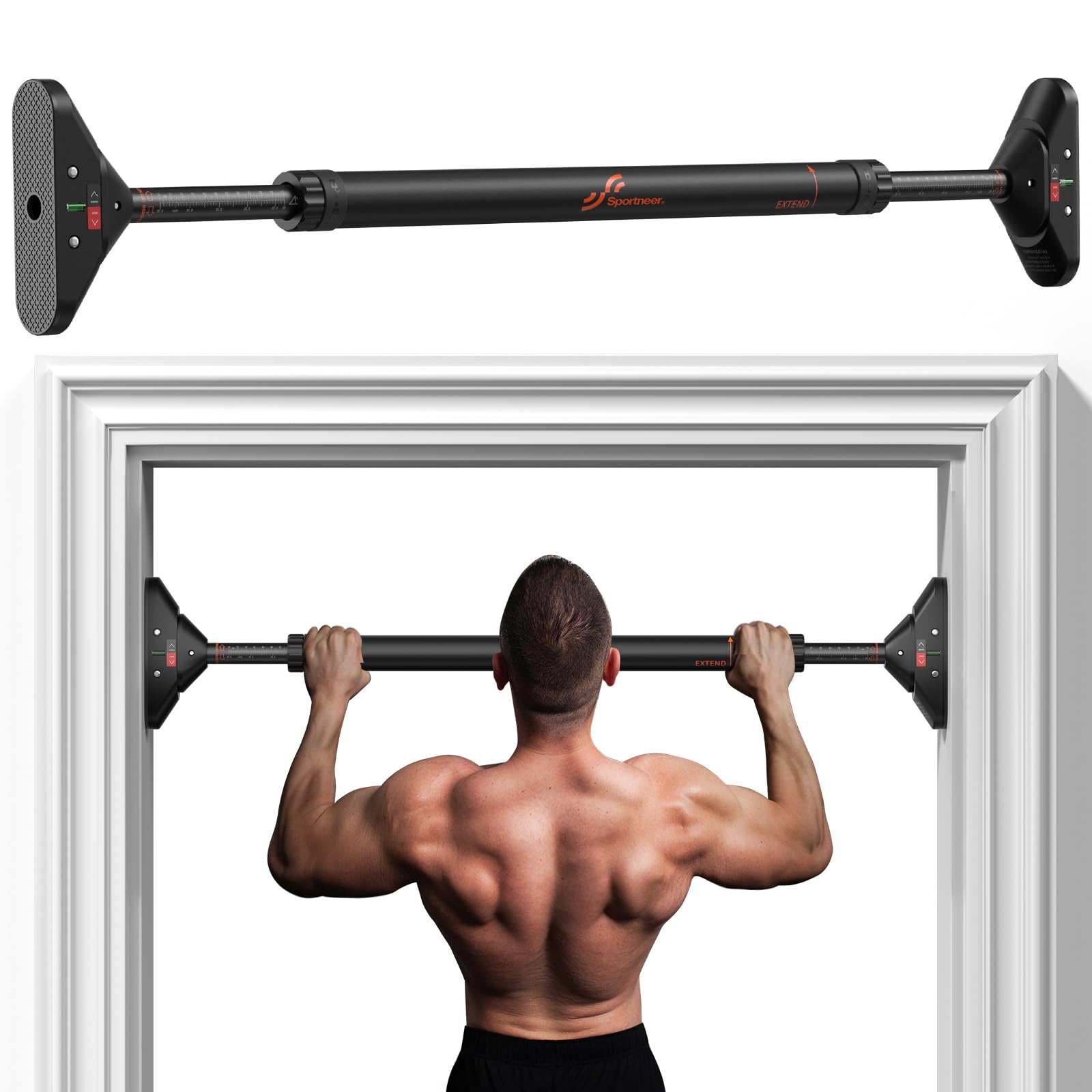
Pull Up Bar: Strength Training Chin up Bar No Screws Adjustable
Sportneer holds a 4.3 star average across 6,323 verified Amazon reviews. Maria wrote: “Let me tell you, it's been a game changer. I bought this for me to learn how to do pull ups and improve my grip strength but my brother were interested in it as well. My brothers are on the bigger side between 250 to…”
- Before purchasing
- To ensure safety
- No Drilling
- Heavy Duty Construction
What we like
- Before purchasing, ensure your door frame width is between 29.5 37 inches (75 to 94 cm). This chin up bar is not suitable for frames…
- To ensure safety, the manual specifies a maximum load of 297 lbs (135 kg). Testing shows the product can handle up to 744 lbs (337.5 kg)…
- No Drilling, No Traces: The pull up bar uses innovative fixative technology to stay in place. It features two large 6.5 x 1.8 inch PVC…
- Heavy Duty Construction: Our Pull Up Bar supports up to 440 lbs (200 kg) with its 2 mm outer and 1.5 mm inner steel pipes. This pull up…
Watch out for
- I got this March 16th, was excited to start using it, and was immediately put off by the horrendous smell coming off

Pull Up Bar for Doorway,Multiple Levels Width Adjustable Pull Up Bar
Ally Peaks holds a 4.4 star average across 972 verified Amazon reviews. johnniebod wrote: “Very impressed with this pull up bar. I must admit that I bought it because it was very affordable. Assembly was quick and easy with the included tools. Mounted fast and securely to 90 year old molding. Has no trouble…”
- Real adjustable width design can match
- HEAVY DUTY CONSTRUCTION,HOLD UP TO 500 LBS
- Updated the traditional foam that
- Target multiple upper body & core muscles
What we like
- Real adjustable width design can match your doorway more accurately, even doors in the corner. This door frame pull up bar has 5 levels of…
- HEAVY DUTY CONSTRUCTION,HOLD UP TO 500 LBS: The pullup bar make from 1.7mm thickened chrome steel.Original no break in the middle, double…
- Updated the traditional foam that contacts the door frame to elastic silicone.Permanent use,can never be broken,better fits and protects…
- Target multiple upper body & core muscles with pull ups, push ups, dips, and hanging crunches.These multiple functions make working out…
Watch out for
- This pull up bar has quite comfortable handles and is easy to install
- Feels stronger than the one I'm replacing, but one of the silicone pads was missing

Pull Up Bar Doorway with Ergonomic Grip Fitness Chin Up Frame for Home
AmazeFan holds a 4.6 star average across 3,789 verified Amazon reviews. Pranali M wrote: “I started my pull up journey with this bar, and I’m really happy with it! The ergonomic grip is excellent and makes exercises much more comfortable. It fits perfectly in our doorway, and the bar feels very sturdy no…”
- 💪【ERGONOMIC PULL UP BAR】 The Ergonomic
- 💪【SIMPLE INSTALLATION AND MULTI PURPOSE】
- 💪【MULTI ANGLE GRIP】 2024 Upgrade Smart
- 💪【DOORFRAME PROTECTION】 The 2 detachable
What we like
- 💪【ERGONOMIC PULL UP BAR】 The Ergonomic Multi Angled Grips Pull Up Bar, ideal for exercising and increasing the width of the latissimus…
- 💪【SIMPLE INSTALLATION AND MULTI PURPOSE】 Simple Assembly, Hang It On The Door Frame To Start Exercising Immediately, Solid Steel…
- 💪【MULTI ANGLE GRIP】 2024 Upgrade Smart Hook, allowing users to train with various grips to target different muscle groups and enhance…
- 💪【DOORFRAME PROTECTION】 The 2 detachable buffer Premium silicone pads can prevent damage to your door frame.The bar leaves no mark on…
Watch out for
- No common complaints in top verified reviews

Door Pull Up Bar Doorway Frame Chin Up Bar from 28.3in 38.2in,No
PROIRON holds a 4.5 star average across 587 verified Amazon reviews. PS wrote: “The bar works! It is easy to install, stays secure, and tolerates all that I do on it. It's a must have for serious athletes. Recommend.”
- 💪 【Special Attention】Before purchasing
- 💪 【Upgraded Security】The two ends of
- 💪 【Firmly Locked】Upgraded double gear
- 💪 【Easy Installation:No Drilling
What we like
- 💪 【Special Attention】Before purchasing, ensure your door frame width is between 28.3 38.2 inches (72 to 97 cm). This chin up bar is not…
- 💪 【Upgraded Security】The two ends of this pull up bar are our original design of the spring automatic extrusion setting. When the gravity…
- 💪 【Firmly Locked】Upgraded double gear lock design, locking and anti rotation design to prevent the lever from loosening and rotating. The…
- 💪 【Easy Installation:No Drilling, NO Traces】Our pull up bar doorway installation is not tilted through Two High precision spirit level,…
Watch out for
- Only recommended if you absolutely know you have rock solid construction

Pull up bar for door frames for hanging without screws and no slipping
PULLUP & DIP holds a 4.6 star average across 1,874 verified Amazon reviews. David Miro wrote: “Fir perfect. You can feel the stability so its safe for me (I'm 80 kg). I compare it with the Reebok the selling in the Walmart, this one way better for its money!.”
- ✅ SECONDS FAST ASSEMBLY & NO SLIPPING
- ✅ NUMEROUS EXERCISES & GRIP POSITIONS
- ✅ HIGHER THAN OTHER MODELS & NO DAMAGE TO
- ✅ HIGH SAFETY
What we like
- ✅ SECONDS FAST ASSEMBLY & NO SLIPPING: The door pull up bar without screws is securely attached to the door frame within seconds without…
- ✅ NUMEROUS EXERCISES & GRIP POSITIONS: The doorway pull up bar allows you to do numerous exercises such as pull ups with different grips…
- ✅ HIGHER THAN OTHER MODELS & NO DAMAGE TO DOOR FRAME: The chin up bar handles are designed to be higher than comparable models for…
- ✅ HIGH SAFETY: The reinforced construction with cross bars and high strength screw connections ensures maximum stability and a safe…
Watch out for
- No common complaints in top verified reviews

Pull Up Bar for Multi Use Fitness & Home Gym Exercise Multi Grip Light
ProsourceFit holds a 4.4 star average across 9,434 verified Amazon reviews. Remy wrote: “Best pull up bar I’ve owned. Very stable, looks very cool, and easy to assemble. For perfectly into my door frame.”
- COMFORTABLE GRIP 8 non slip foam grips
- MULTI FUNCTION Target multiple upper
- EASY TO USE Portable design easily fits
- HEAVY DUTY CONSTRUCTION Made of high
What we like
- COMFORTABLE GRIP 8 non slip foam grips to comfortably perform wide, narrow and neutral grip exercises
- MULTI FUNCTION Target multiple upper body & core muscles with pull ups, push ups, dips and hanging crunches
- EASY TO USE Portable design easily fits on any standard doorway 24" to 32" and is simple to assemble and install
- HEAVY DUTY CONSTRUCTION Made of high grade steel that’s built to last and holds up to 300 pounds
Watch out for
- No common complaints in top verified reviews
Frequently Asked Questions
Do doorway pull up bars damage door frames?
Most leverage mounted pull up bars distribute weight through rubber padded contact points on the door frame, which prevents scuffing and denting when used correctly. However, repeated heavy use can leave marks on painted trim, especially with heavier users. Adding foam pads or microfiber towels between the bar and frame provides extra protection. Telescoping bars that press against the inner door jamb carry a slightly higher risk of chipping paint if they slip.
How much weight can a doorway pull up bar hold?
Most quality doorway bars are rated for 220 300 lbs, with some heavy duty models supporting up to 400 lbs. The weight limit depends on both the bar design and the strength of your door frame. Solid wood frames handle the load better than hollow or MDF trim. Always check the manufacturer rating and ensure your door frame is structurally sound before use look for cracks, loose screws, or soft spots.
What width doorway do I need for a pull up bar?
Standard leverage mounted bars fit doorways between 24 and 36 inches wide, which covers most residential doors. Some models extend to 38 or even 42 inches for wider openings. Measure the inside width of your door frame before buying. Telescoping bars are more flexible on width but require the frame to have flat, parallel surfaces to grip securely.
Are doorway pull up bars safe?
When properly installed on a sturdy door frame and used within their rated weight capacity, doorway pull up bars are safe for regular exercise. The most common cause of accidents is incorrect installation not seating the bar fully on the frame or using it on a weak or damaged door jamb. Always test the bar with a gentle pull before doing a full hang, and avoid kipping or swinging movements that create dynamic loads beyond the static weight rating.
What exercises can I do with a doorway pull up bar?
Beyond standard pull ups and chin ups, most doorway bars support hanging leg raises, knee raises, dead hangs for grip strength, and negative pull ups for building strength. Models with multiple grip positions let you do wide grip, close grip, and neutral grip variations to target different back and arm muscles. Some bars can also be placed on the floor for push up variations and dips, effectively giving you a full upper body workout station.
The Bottom Line
A doorway pull up bar is the highest impact piece of home gym equipment you can buy for under affordable. Leverage mounted bars offer the best balance of stability, versatility, and frame safety for most standard residential doorways. Look for one with multiple grip positions and foam padding, the ability to vary your grip turns a single bar into a complete upper body training tool.
If stability is your top concern, a wall mount bar is worth the permanent installation. For everyone else, a quality leverage bar installs in seconds and removes cleanly when you move out. Pair it with resistance bands for assisted pull ups if you are still building strength, and explore our full fitness equipment collection for more home gym essentials.
Opens your browser's print dialog. Choose Save as PDF as the destination.
People also search for
- Amazon Basics vs Gorilla Mats Exercise Mat
- Tribe Lifting vs WODFitters Resistance Band
- HYDROWION vs RAYMYLO Summer Water Bottle
- best exercise mat for home gym
- best foam roller for back pain
- Best Exercise Mats for Home Gym: Thick, Grippy, and Built to Last
- Best Foam Rollers for Back Pain: Tested for Relief and Recovery
- Best Affordable Adjustable Dumbbells: Replace an Entire Rack